Traditional UV absorbance tests often require benchtop spectrophotometers and lab workflows that are slow, expensive, and hard to deploy widely. This is a significant hurdle because ultraviolet measurements are deeply useful in biomedical and chemical analysis, including assays that track analytes and proteins in blood serum and urine. A practical near-UV platform that travels with the user would push testing closer to where decisions are made.
The Challenge of Near-UV Sensing
Nature already has a “cheat code” for this. Many insects can see ultraviolet patterns on flowers that humans cannot, because UV carries information invisible in the normal visible range. While the near-UV region is information-rich for many molecules, most low-cost imaging tools—like smartphones—ignore it.
Smartphone colorimeters have been widely demonstrated in the visible spectrum, but extending these platforms into the ultraviolet domain has remained a bottleneck. Despite being medically relevant, smartphone-based near-UV colorimetric sensing has remained largely unexplored—until now.
Our Solution: A Smartphone-Based Colorimeter
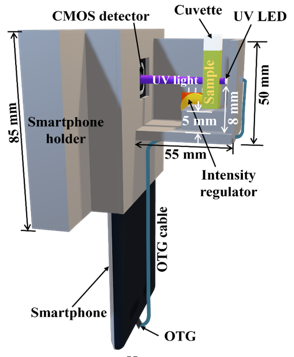
In our newly published paper, we address this gap by proposing near-UV colorimetric sensing and analysis using a smartphone’s built-in imaging and processing capabilities. Our approach leverages the fact that modern CMOS cameras, while optimized for visible light, still retain measurable responsivity in the near-UV.
Key features of the system include:
- Integrated UV LED: A compact external source provides stable, uniform illumination for precise absorbance quantification.
- All-in-One Pipeline: The smartphone handles processing, visualization, and data storage without extra computing hardware.
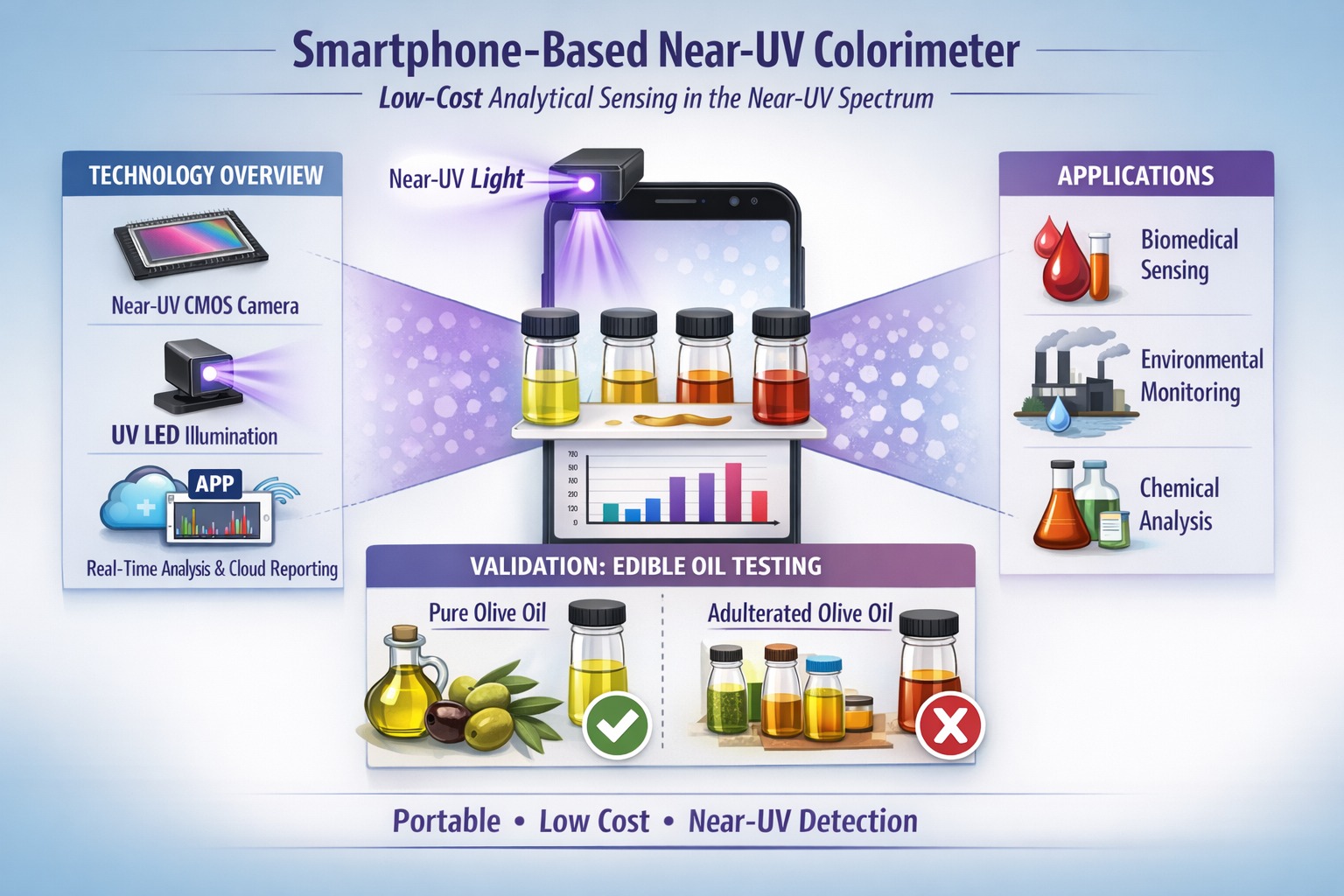
- Android Application: A dedicated app enables real-time analysis and cloud-assisted geospatial reporting, allowing measurements to be tracked and mapped across locations.
Validating Food Safety and Quality
We validated the platform by tackling a high-impact food safety problem: detecting adulteration in extra virgin olive oil. By measuring absorbance variations from UV-sensitive molecular components, the device successfully:
- Distinguished cross-adulteration among multiple edible oils.
- Monitored pigment degradation under sunlight exposure.
Broader Impact and Future Applications
This work moves near-UV measurement toward an accessible, low-cost, and connected form factor, reducing dependence on centralized laboratories. Looking forward, this framework can extend beyond edible oils into:
- Biomedical Optical Sensing: Assays for serum and urine.
- Chemical Quality Monitoring: Industrial and food authentication.
- Environmental Detection: Monitoring pollutants in real-time at scale.
Published in: Optics Continuum (December 2025)
Full Research Paper:DOI: 10.1364/OPTCON.582107